Digital marketing agencies operate in a fast-moving environment where creativity, communication and coordination must work together. Managing multiple client accounts, planning campaigns, producing content, tracking advertising activities and meeting delivery deadlines require continuous collaboration between different teams.
An agency might manage social media campaigns for one client, handle SEO for another and develop a website for a third. Each engagement comes with its own requirements, deliverables, deadlines, communication and reporting expectations. Maintaining strong client relationships while coordinating these activities can become challenging as the agency expands.
When these processes are managed through disconnected applications, important information can become scattered. Client conversations may remain in emails, campaign tasks may be tracked in spreadsheets and employee working hours may be recorded separately. This makes it difficult for account managers to maintain a complete view of client requirements, monitor project progress and identify opportunities for business growth.
Odoo offers an integrated business management platform that connects customer relationship management, project execution, marketing activities and financial operations. Its modular structure allows digital marketing agencies to select applications according to their operational requirements and build connected workflows as their business grows.
1. How Can Odoo CRM Strengthen Client Relationships?
Client relationships are central to the success of every digital marketing agency. From the first inquiry to contract renewal, agencies need a structured approach to managing prospects, understanding client requirements and maintaining consistent communication.
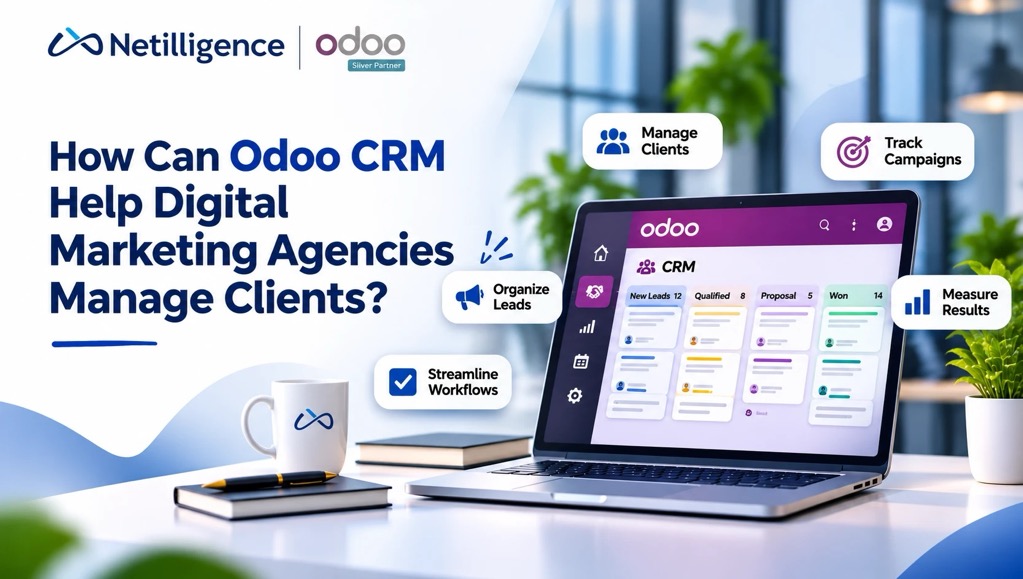
Odoo CRM helps agencies organise leads and track sales opportunities through a visual pipeline. Sales representatives can record prospect information, schedule follow-ups, document meetings, manage activities and monitor the progress of potential business opportunities.
For example, when a business approaches an agency for SEO services, the inquiry can be recorded as a lead. The sales team can document its requirements, discuss the expected deliverables, schedule meetings and move the opportunity through stages such as New, Qualified, Proposal Sent and Won.
The CRM also provides access to communication history and scheduled activities associated with customer records. This allows account managers and sales representatives to review previous interactions before contacting a prospect or following up on a proposal.
For agencies handling multiple client inquiries simultaneously, this structured approach can reduce the risk of missed follow-ups and overlooked opportunities.
By maintaining organised customer information and tracking every stage of the sales process, Odoo CRM helps agencies build a more consistent approach to client acquisition and relationship management.
2. How Can Agencies Coordinate Campaign Projects with Odoo?
Every digital marketing campaign involves multiple activities that must be completed in the right sequence. A social media campaign may require content calendars, graphic design, copywriting, client approvals and publishing schedules. An SEO engagement may involve keyword research, technical audits, content optimisation and performance reviews.
Odoo Project helps agencies organise these activities into projects and individual tasks. Managers can assign responsibilities, establish deadlines, monitor task progress and organise work according to specific client requirements.
For instance, an agency managing a monthly social media campaign for a retail client can create separate tasks for content planning, promotional creatives, caption writing, client feedback and scheduled publishing. Each task can be assigned to the relevant specialist with a defined deadline.
The application also provides different ways to view and manage project activities, including task boards and project timelines, depending on the configuration.
This creates a more structured workflow where designers, content writers, account managers and marketing specialists can understand their responsibilities and track pending activities.
Connecting project management with client records and other business applications can also give agency managers better visibility into ongoing engagements and delivery progress.
3. Which Odoo Marketing Applications Support Agency Campaigns?
Digital marketing agencies need to coordinate their own promotional activities while managing communication for different clients. Email campaigns, automated follow-ups and social media publishing are some of the activities that require regular attention.
Odoo provides applications such as Email Marketing, Marketing Automation and Social Marketing to support different marketing workflows.
- Email Marketing: Agencies can create email campaigns, organise mailing lists and communicate with selected audiences. This can support promotional campaigns, newsletters and customer engagement activities.
- Marketing Automation: Agencies can configure automated communication workflows based on defined triggers and conditions. For example, a prospect who registers through a campaign can receive a sequence of relevant follow-up emails based on their interaction.
- Social Marketing: Agencies can manage supported social media accounts, organise content and schedule posts through the application. This can help coordinate selected social media publishing activities.
These applications can bring several marketing workflows into the Odoo environment. However, specialised advertising management, advanced social listening, influencer campaign management and detailed cross-platform analytics may still require dedicated external platforms.
4. How Can Timesheets Improve Agency Productivity?
Digital marketing projects often involve several specialists working on the same client account. Designers, content writers, SEO specialists, developers and account managers contribute different amounts of time to each engagement.
Without accurate time tracking, agencies may struggle to understand how much effort individual projects require or whether the resources allocated to a client are sufficient.
Odoo Timesheets allows employees to record working hours against specific projects and tasks. Managers can review recorded time, monitor resource allocation and compare actual hours with estimated project requirements.
For example, an agency may allocate a fixed number of hours each month to a client’s social media account. Timesheet records can help management understand whether the team is staying within the planned allocation or spending additional time on revisions, new requests and unexpected changes.
This information is particularly useful for agencies operating on monthly retainers or hourly billing models. By reviewing the time spent on individual client accounts, managers can evaluate resource utilisation, improve workload planning and identify projects that require adjustments to their pricing or scope.
5. How Can Odoo Simplify Proposals and Client Billing?
Digital marketing agencies offer different services under different pricing arrangements. Some charge fixed project fees for website development, while others operate through monthly retainers for SEO, social media management or content production. Some engagements may also involve hourly billing.
Odoo Sales helps agencies prepare quotations, define service offerings and manage sales orders. Agencies can create service descriptions for SEO management, website development, content production and paid advertising management, then prepare proposals based on client requirements.
Once a proposal is approved, the relevant sales information can support subsequent project and billing workflows.
Odoo Invoicing and Accounting can help manage customer invoices, monitor payments and maintain financial records. Depending on the agreed billing arrangement and system configuration, agencies can also organise recurring invoices for ongoing client services.
For example, an agency providing monthly SEO services can manage its service agreement and organise recurring billing according to the agreed payment schedule.
Connecting sales, project and financial activities can reduce repetitive administrative work and give management a clearer view of quotations, outstanding payments and business transactions.
6. How Can Odoo Improve Team Collaboration and Client Communication?
Successful campaign delivery depends on clear communication between account managers, creative teams, marketing specialists and clients.
When project updates and client feedback are scattered across emails, messaging applications and spreadsheets, employees may struggle to identify the latest instructions or understand which revisions are pending.
Odoo provides collaboration features such as activity scheduling, Chatter discussions and internal communication tools within relevant applications.
Employees can use these features to document updates, share information, assign follow-up activities and coordinate tasks associated with customer or project records.
For example, when a client requests changes to a social media campaign, an account manager can record the feedback against the relevant business record and coordinate the required revisions with the creative team.
This helps keep important discussions connected to the relevant business activities instead of relying entirely on separate communication channels.
For advanced client approval portals, creative proofing and specialised feedback workflows, additional configuration or third-party integrations may be necessary.
7. How Can Agencies Track Performance with Odoo?
Agency growth depends on understanding more than the number of clients acquired. Managers also need to evaluate which services generate revenue, how resources are being used and whether projects are being delivered efficiently.
Odoo’s reporting capabilities across CRM, Project, Timesheets and Accounting can help agencies review different aspects of business performance.
For example, CRM reports can provide insights into sales pipeline progress and opportunity conversion. Project information can help managers review task completion and delivery status, while timesheet records offer visibility into the hours spent on individual engagements. Financial reports can support the evaluation of revenue, expenses and outstanding payments.
These insights can help agency managers answer important operational and commercial questions:
- Which services are generating more business?
- How many sales opportunities are converting into clients?
- Are projects being completed within their estimated timelines?
- Which client accounts require additional resources?
- How much time is spent on revisions and additional requests?
- Are recurring client engagements financially sustainable?
By bringing information from different business functions together, agencies can develop a clearer understanding of their operations and make more informed decisions about resource allocation, service pricing and future growth.
8. Which Odoo Applications Does a Digital Marketing Agency Need?
Not every digital marketing agency requires the same software setup. A small creative agency may primarily need CRM, Project, Timesheets and Invoicing, while a larger agency may require additional applications for marketing automation, sales management, employee administration and accounting.
A practical starting point is to identify the agency’s most time-consuming processes and select applications that address those requirements.
A typical application combination may include:
- CRM: Managing leads, prospects, sales opportunities and follow-ups.
- Project: Organising campaign deliverables, tasks and deadlines.
- Timesheets: Recording working hours and monitoring resource utilisation.
- Sales: Preparing quotations and managing service orders.
- Invoicing and Accounting: Handling billing, payments and financial records.
- Email Marketing and Marketing Automation: Coordinating email campaigns and automated communication.
- Social Marketing: Managing supported social media publishing activities.
The implementation should also consider the agency’s existing technology ecosystem. Businesses using specialised platforms for advertising, analytics, social media management or creative collaboration may need integrations to connect those systems with Odoo.
A phased implementation can make the transition easier. Agencies can begin with client management and project workflows, then expand into marketing applications and financial reporting as their requirements evolve.
Build a More Connected Digital Marketing Agency with Odoo
Running a successful digital marketing agency requires more than creative talent. Building lasting client relationships, coordinating campaigns, tracking employee productivity and maintaining financial control are equally important to sustainable growth.
Odoo provides an integrated environment that can connect these business functions through its modular applications. From tracking prospective clients through CRM to managing campaign deliverables, recording employee hours and monitoring financial performance, agencies can establish more structured and connected workflows.
With the right applications, configuration and implementation approach, Odoo can help digital marketing agencies reduce administrative complexity, improve operational visibility and create a stronger foundation for business growth.
When client relationships, campaign delivery and internal operations work together, agencies can spend less time coordinating disconnected processes and more time delivering meaningful results for their clients.