A furniture manufacturing business can have skilled workers, modern machinery and a steady flow of customer orders, yet still struggle to meet delivery deadlines. A shortage of plywood, incorrect measurements, excess material wastage or an unexpected production change can disrupt the entire workflow.
These challenges become more complicated when manufacturers handle different product designs, custom orders and varying material requirements. A dining table, a modular wardrobe and an office workstation may require different components, production processes and finishing methods.
Managing these activities through separate spreadsheets and disconnected systems makes it difficult to maintain control over production, inventory and costs.
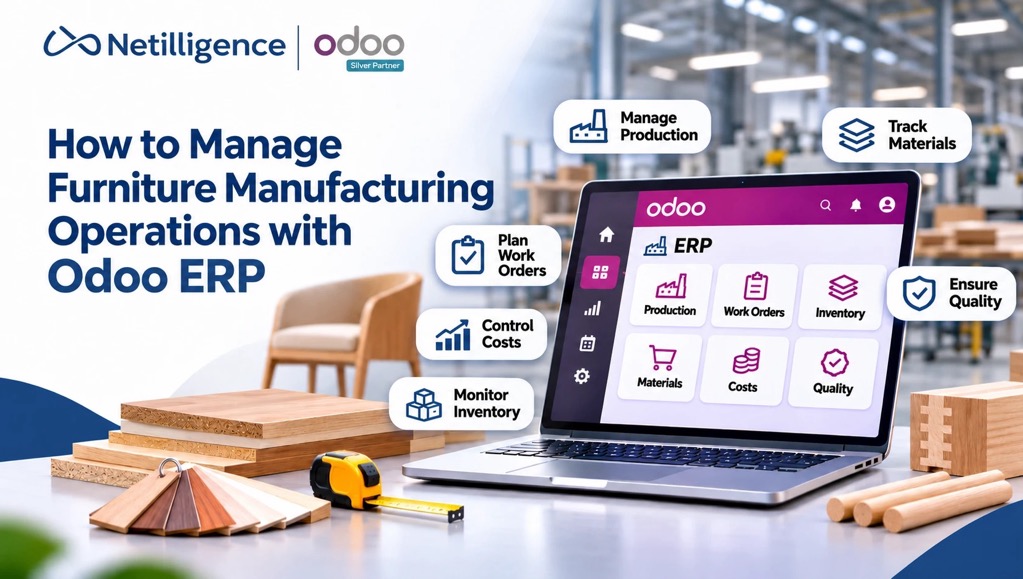
Odoo ERP for furniture manufacturing helps businesses connect important operations through applications such as Manufacturing, Inventory, Purchase, Sales and Accounting. With the right configuration, manufacturers can organise production workflows, monitor material availability and gain better visibility into their operations.
Let’s explore how Odoo can support furniture manufacturers at different stages of production.
1. Plan Production Around Customer Orders
Furniture manufacturers often need to balance confirmed customer orders with regular production requirements. Starting production without checking material availability or machine capacity can result in unfinished products and missed deadlines.
Odoo Manufacturing helps businesses create manufacturing orders, define production operations and organise work through work orders and work centres.
For example, a manufacturer producing 50 office desks can divide the production process into cutting, edge banding, drilling, assembly and finishing. Each operation can be assigned to a relevant work centre, helping managers monitor production progress.
This makes it easier to identify pending activities and understand where production delays are occurring.
For businesses handling multiple orders, structured production planning also helps coordinate resources and manage workloads more effectively.
2. Manage Raw Materials and Inventory
Furniture production depends on the availability of materials such as timber, plywood, MDF boards, laminates, hinges, screws, adhesives and finishing products. A shortage of even one essential component can interrupt production.
On the other hand, purchasing excess materials increases storage requirements and ties up working capital.
Odoo Inventory helps businesses track stock quantities, manage warehouse movements and monitor incoming and outgoing materials. Reordering rules can also support replenishment planning based on configured stock requirements.
Consider a manufacturer preparing to produce a batch of wardrobes. Before production begins, the team needs to check the availability of plywood boards, hinges, drawer runners and handles. Reviewing stock records helps identify which materials are available and which need to be reordered.
For manufacturers handling different material dimensions, timber grades and reusable offcuts, additional configuration may be required to track consumption and wastage accurately.
3. Handle Custom Furniture Orders and Product Variants
Furniture customers often request specific dimensions, colours, finishes, fabrics and hardware. Managing these variations manually can create confusion between sales teams and production workers.
For instance, a customer ordering a modular wardrobe may choose a particular height, width, laminate finish and internal storage arrangement. If these specifications are not communicated accurately, the production team may manufacture the wrong version.
Odoo Sales helps businesses manage quotations and customer orders, while product variants and Bills of Materials (BoMs) can support different product specifications.
A manufacturer can configure product variants for different sizes or finishes and define the relevant components required for production.
For highly customised furniture, additional workflows may be needed to manage technical drawings, customer-approved measurements and design revisions.
Connecting customer requirements with production records helps reduce misunderstandings and ensures that manufacturing teams work with the correct specifications.
4. Coordinate Purchasing with Production Requirements
Production schedules depend on materials arriving at the right time. If essential components are unavailable, manufacturing may stop midway, even when workers and machinery are ready.
Odoo Purchase helps businesses manage supplier quotations, purchase orders and procurement records. When connected with Inventory and Manufacturing, purchasing teams can make decisions based on material availability and upcoming production requirements.
For example, if a furniture manufacturer has enough plywood but insufficient hinges for an upcoming wardrobe order, the purchasing team can identify the shortage and arrange replenishment before production begins.
Supplier lead times and expected delivery dates can also be considered during purchasing decisions.
This creates a more organised procurement process and helps manufacturers avoid unnecessary orders and production interruptions.
5. Monitor Material Wastage and Manufacturing Costs
Material wastage is a common challenge in furniture manufacturing. Incorrect cutting measurements, damaged boards, finishing defects and repeated work can increase production expenses.
Odoo Manufacturing supports manufacturing order costing and can account for configured component and work-centre costs. Production records can also help businesses review material consumption and manufacturing performance.
For example, a manufacturer estimating the cost of a dining table may calculate the required timber, hardware and labour expenses. If actual production consumes more material or takes longer than expected, the business can review the recorded information to investigate the difference.
Odoo’s scrap functionality can also help record materials or products that cannot be used.
However, accurate wastage analysis depends on proper shop-floor records. Manufacturers may need additional processes to track cutting plans, reusable offcuts, damaged materials and product-specific consumption.
Monitoring these details helps businesses improve production estimates and identify opportunities to reduce unnecessary expenses.
6. Maintain Quality at Every Production Stage
A furniture product may appear complete but still have issues with measurements, fittings, surface finishing or structural assembly. Identifying these problems only after delivery can result in repairs, returns and additional costs.
Odoo Quality supports quality checks and quality alerts within configured manufacturing workflows.
For example, a manufacturer can establish inspection points after cutting, during assembly and before final packaging. Workers can check dimensions, fittings and finishing quality at the relevant stages.
If a defect is identified, recording the issue helps the business investigate recurring problems and improve its production processes.
For manufacturers with specialised testing requirements, additional tools or integrations may be necessary.
7. Connect Manufacturing with Sales and Accounting
Production information becomes more valuable when it is connected with other business departments.
Sales teams need to understand order progress, purchasing teams need accurate material requirements, and finance teams need visibility into manufacturing expenses.
Odoo connects relevant workflows through its integrated applications. Customer orders can support production planning, material requirements can inform purchasing decisions, and accounting records can help businesses monitor supplier bills, customer invoices and expenses.
This reduces the need to maintain separate records for every department and helps teams work with more consistent information.
The exact workflow depends on the applications selected and the business processes configured.
Choosing the Right Odoo Setup for Furniture Manufacturing
Not every furniture manufacturer requires the same ERP configuration. A small workshop producing made-to-order furniture may prioritise quotations, production tracking and material purchasing. A larger factory may need work-centre planning, multi-warehouse inventory, quality checks and detailed manufacturing cost analysis.
The starting point should be identifying the processes that create the greatest operational difficulties. Businesses can then select suitable Odoo applications and determine where standard functionality, customisation or integrations are required.
A phased implementation can also help employees adopt essential workflows before expanding the system to other business operations.
Furniture manufacturing requires coordination between customer specifications, raw materials, production activities, quality checks and delivery schedules. When these processes operate separately, even small mistakes can lead to delays, wasted materials and increased production costs.
Odoo ERP provides furniture manufacturers with an integrated platform to manage production planning, inventory, purchasing, sales and accounting. With the right configuration, businesses can improve material planning, organise manufacturing workflows and make more informed operational decisions.
For growing furniture manufacturers, the objective is not simply to produce more products. It is to manage every order with greater consistency, control resources effectively and maintain better visibility across the entire production process.