Manual planning vs Odoo Planning is a comparison that’s becoming more relevant each year. As businesses grow and teams expand, the tools we once relied on, whiteboards, spreadsheets, and paper ledgers, show trials. In Odoo 18, the Planning module has been refined and reimagined to make scheduling smarter, faster, and more intuitive than ever before.
But is switching worth it? Is it just about automation, or does it fundamentally change how we work? Let’s dive into the heart of the matter and find the differences between manual planning and Odoo Planning, how the comparison of Odoo 18 planning shapes this decision, and why this switch could be your business’s best investment this year.
Odoo 18 Planning Comparison: What's Different This Time?
With the launch of Odoo 18, one of the most noticeable upgrades comes from the Planning module. A sleek, updated UI, more innovative automation, and better integration across HR and project apps make it stand out. The Odoo 18 planning comparison against previous versions, especially against manual systems, is not just a game of aesthetics; it’s about performance, efficiency, and user empowerment.
Previously, a team manager working with spreadsheets might spend hours checking each employee’s availability, manually adjusting shifts, rechecking for overlaps, and emailing confirmations. Now, with Odoo 18, all that is handled within a few clicks. The system even flags conflicts before you see them. The shift from manual to Odoo Planning isn’t just an upgrade; it’s an operational modification.
Manual Planning vs Odoo Planning: The Real World Showdown
It’s tempting to believe manual planning still works, and it has for decades. But let’s consider what it involves. Picture a restaurant manager printing schedules every week, crossing out names, rewriting shift times, and taking calls from employees asking for changes. Multiply that by 10 teams across three branches, and you’ll start to see the chaos manual planning invites.
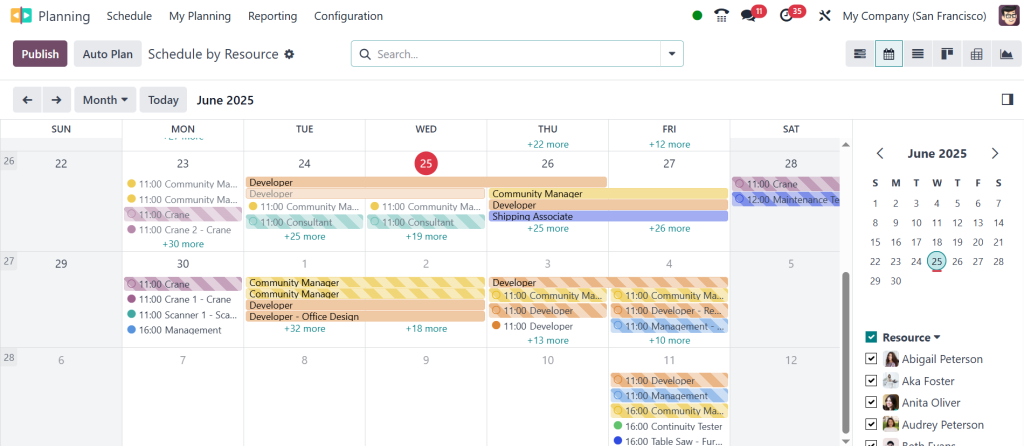
Now compare that to Odoo Planning in Odoo 18. The manager logs in, views staff availability through a visual calendar, uses drag-and-drop to assign shifts and lets employees confirm or decline them through their portal, with no phone calls. No printing. No back-and-forth. The manual planning vs Odoo Planning debate ends when you witness this efficiency in action.
Odoo Planning vs Spreadsheet Planning: Why Spreadsheets Are No Longer Enough
Spreadsheets have long been the go-to tool for managers. Flexible? Yes. Reliable? Sometimes. Scalable? Not really. In theory, a spreadsheet can manage your shifts and assignments. In practice, it becomes a monster of tabs, filters, and cell formulas that break every time you copy-paste.
In the battle of Odoo Planning vs spreadsheet planning, Odoo wins by eliminating friction. Instead of tracking dozens of sheets, Odoo offers a centralized dashboard where all teams, shifts, leaves, and contracts live harmoniously. You don’t just view data; you act on it instantly.
Need to reschedule due to a sudden leave? Drag the shift. Need to see who’s available with a particular skill set? Filter and assign. Spreadsheets can’t do this without hours of manual work. And in a world where time is money, Odoo Planning puts you miles ahead.
Manual Scheduling vs Automated Planning: The Speed Advantage
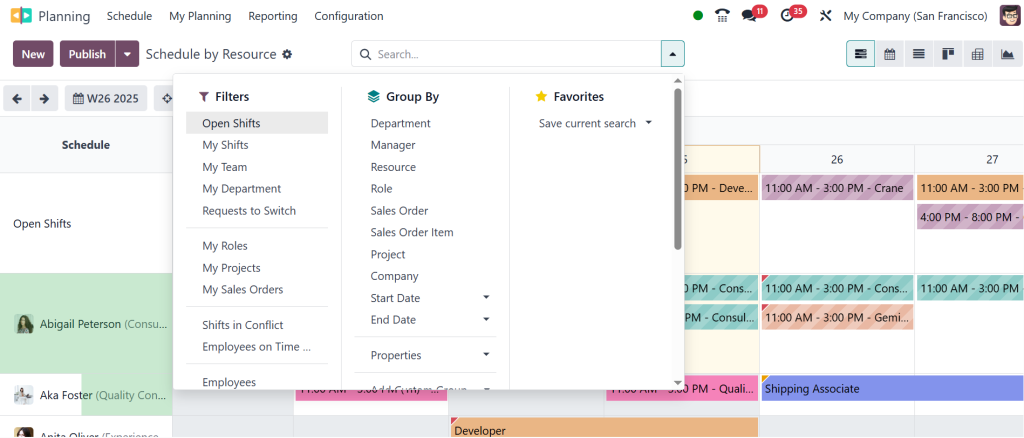
Let’s talk about time. In business, response time can be everything. Manual scheduling eats up time like a black hole between collecting availability, checking for overlaps, sending out schedules, managing exceptions, and adjusting for absences; it’s a repetitive and exhausting cycle.
This is where manual scheduling vs automated planning becomes a turning point. With Odoo’s automated planning engine, you can define templates, shift patterns, and employee constraints, and the system does the heavy lifting. It sends alerts, applies logic, and adapts based on holidays or employee preferences.
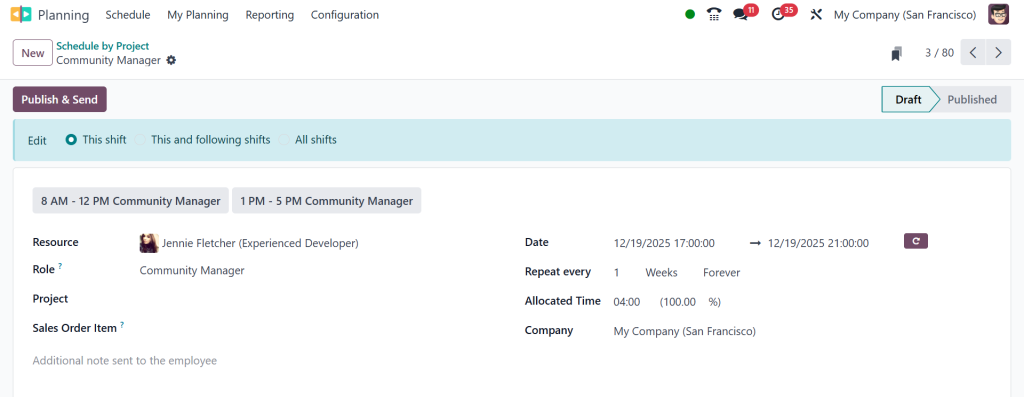
You’re no longer chasing the schedule. You’re managing from the front seat with intelligence and time on your side.
Manual Shift Planning vs Odoo: A Shift Manager's Perspective
Let’s imagine the daily life of a shift manager in retail. You’re handling ten employees with varying availability. Some prefer mornings, others are part-time, a few are on vacation next week, and one just requested a last-minute leave. You’d be recalculating everything by hand or on a chaotic Excel sheet in a manual system.
Now, enter Odoo. In a few clicks, you open the Planning module. You apply a filter to exclude those on leave. You let Odoo suggest an optimal schedule. You review it, make minor tweaks, and publish. Done. It’s not just a time-saver; it’s a life-saver.
The comparison of manual shift planning vs Odoo is clear versus clutter. Manual methods are reactive. Odoo is proactive.
Benefits of Odoo Planning Module You Can't Ignore
So, what exactly are the benefits of the Odoo Planning module? Let’s paint a picture.
Real-time Collaboration: Everyone sees the same schedule, and managers, staff, and HR are all in sync.
Conflict Resolution: Double bookings, understaffed shifts, or overlapping assignments? Odoo flags them instantly.
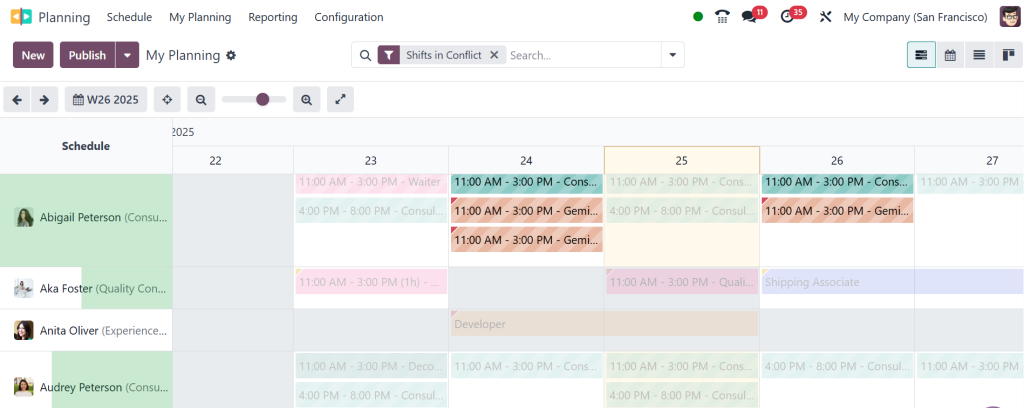
Self-Service Assignment: Employees can view, accept, reject, or request changes to their shifts with no need for dozens of emails or WhatsApp messages.
Integrated Visibility: Know who’s on leave (Time Off), at work (Attendance), and who’s available for overtime all in one view.
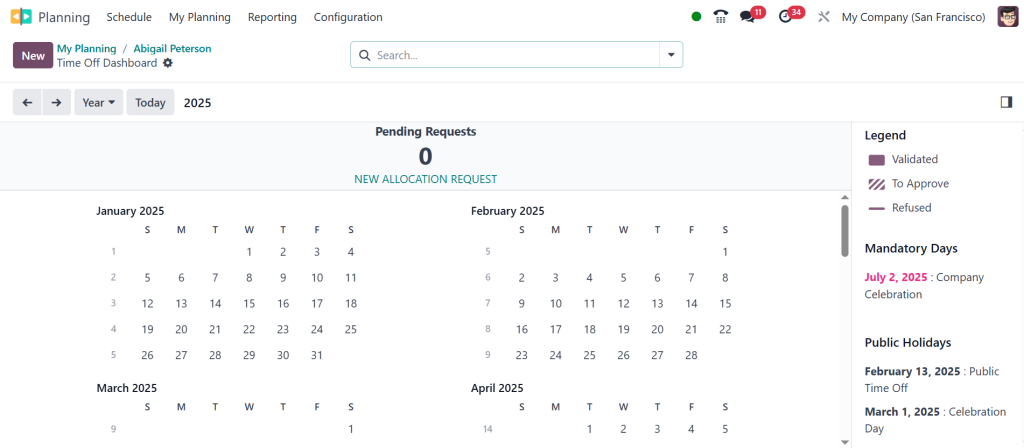
More innovative Planning: Odoo learns. The more you use it, the better it gets at suggesting schedules that work.
And most importantly, it aligns your business planning with your operational goals without the chaos of spreadsheets or the stress of manual oversight.
Odoo Planning Advantages in Fast-Moving Industries
Let’s get practical. Why are retail, manufacturing, healthcare, and services companies rapidly switching to Odoo? Because the Odoo Planning advantages aren’t abstract, they’re felt daily.
Production lines require precise manufacturing coordination of labor, machinery, and materials. A manual planning mistake here means idle machines or overworked teams. Odoo ensures no gaps; everything is aligned by schedule and resource availability.
In healthcare, where shift fatigue can cost lives, Odoo balances workloads rest periods and provides visibility to HR and department heads.
Regression surges can be anticipated and planned in retail (ERP solutions) using templates and rules.
It’s not just about saving time. It’s about gaining control and staying agile in industries where agility means survival.
Why Manual Planning Is No Longer Sustainable in 2025
As we move into 2025, digital change is not a buzzword; it’s a benchmark. Customers expect faster service. Employees expect flexible, transparent workplaces. Manual planning systems can’t deliver either.
From a business continuity perspective, relying on spreadsheets or manual lists is risky. One corrupted file, missed update, or unavailable person can bring the whole system down.
With Odoo Planning in Odoo 18, your data lives in the cloud, backed by access controls, version history, and real-time syncing. You’re always in control, always up to date.
In manual planning vs Odoo Planning, ask yourself: would you run your finances on a calculator when you have accounting software? Then why run your team operations on a spreadsheet?
Why Odoo Planning in Odoo 18 Is the Smarter Choice
Let’s wrap it up. This isn’t just a comparison; it’s a decision that shapes how your business operates daily.
If your team is still doing manual scheduling vs automated planning, you’re spending hours you could save. If you’re stuck comparing Odoo Planning vs spreadsheet planning, you’re sacrificing functionality for familiarity. And if you’re resisting the move from manual shift planning vs Odoo, you’re leaving productivity on the table.
The benefits of the Odoo Planning module go beyond convenience. They offer you clarity, control, and confidence. The advantages of odoo planning are that it makes life easier for managers and everyone in the organization.
So which is the best? The answer is clear: Odoo Planning in Odoo 18. Not because manual planning doesn’t work but because it no longer works well enough for your business’s needs today.
Are you tired of manual planning slowing you down? Let Netilligence help you plan smarter with Odoo 18.